My friend Kootch has noted that I haven't blogged much lately and asked (somewhat facetiously, I think) if I've been busy.
Yes.
I've no doubt that many of us are busy at this time of year, and I can't tell you how much I look forward to tomorrow -- my last day at my day job!
I go to work in the morning, leave there early to go to One Act Play rehearsals, usually have someone who wants to talk to me (about costumes, or sets, or character, etc), then run home to pick up a child for Cub Scouts or Girl Scouts, or wrestling, or basketball, or I have a board meeting for one of the three boards I sit on, then home to help the kids finish up homework, get them in bed, and it's 9pm and I'm bushed. Usually I fall asleep on the couch watching television, to wake up about 3am when one of my boys has to go to the bathroom.
If I do happen to have an evening without obligation, I try very hard NOT to sit in front of my computer.
Monday, December 19, 2005


Monday, December 05, 2005
Death and the actress.
I received a phone call this morning from the woman who will be doing the costumes for the one act play that I am directing for my local high school. Aside from confirming our meeting for later in the day, she thought I ought to know that the student who is playing "Hermia" in our production of A Midsummer Night's Dream lost her father on Saturday to a self-inflicted gun shot.
I haven't been directing for the high school for long, but I had already learned to expect the unexpected and to be prepared for all kinds of strange situations, but I never imagined I'd have to deal with something like this.
I haven't been directing for the high school for long, but I had already learned to expect the unexpected and to be prepared for all kinds of strange situations, but I never imagined I'd have to deal with something like this.
Saturday, December 03, 2005
A prize for bad sex?
Sure enough, there exists an award for bad sex ... in literature. It's called the ... well, it's called The Bad Sex in Fiction Award. The purpose, it would seem (according to the BBC news), is "to draw attention to the crude, tasteless, often perfunctory use of redundant passages of sexual description in the modern novel, and to discourage it".
You can (and should) read the complete article by clicking here.
My vote would have gone to the author who actually wrote: "Oooh la - jolly well - la!"
You can (and should) read the complete article by clicking here.
My vote would have gone to the author who actually wrote: "Oooh la - jolly well - la!"
Friday, December 02, 2005
Thursday, December 01, 2005
Removing the millstone.
It's not been a secret that I couldn't stand the place where I was putting in time and receiving a paycheck.
About a month ago I gave them notice of my intent to leave the job by the end of the calendar year.
Today they had their first interview, and the notice was sent by email to all staff at my place of employ, that my position was available.
I told my wife that this had been done and she sent me just one word in reply: Congratulations.
About a month ago I gave them notice of my intent to leave the job by the end of the calendar year.
Today they had their first interview, and the notice was sent by email to all staff at my place of employ, that my position was available.
I told my wife that this had been done and she sent me just one word in reply: Congratulations.
Tuesday, November 29, 2005
Sick boy creativity.
My youngest son spent the day at home yesterday, sick with a sore throat and slight fever. This child doesn't spend a lot of time alone as he has an older brother and sister and a best friend who lives up the street. When he is with his brother he is usually playing whatever the older brother is playing. Likewise, his best friend is much more of a leader, so my son tends to play whatever the friend plays.
Yesterday, I saw the creativity in my child that we don't usually see, because of his nature to follow along. While sick, he asked his mother if he could have any clothes that he could use to cut up. My wife gave him an old shirt and pair of pants. He disappeared for a long time, came back with the clothes in shreds, and some red fabric cut into strips and scotch taped to his body and said, "I was attacked by a bear."
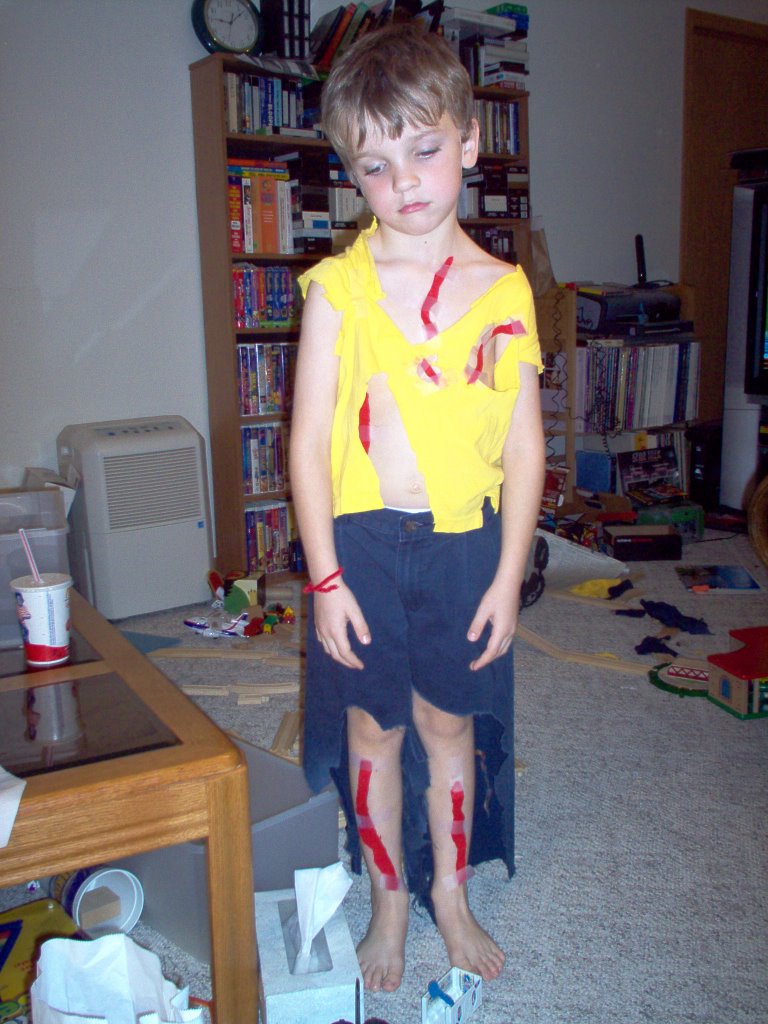 My son in his "I was attacked" pose.
 I just love the creative spirit!
Monday, November 28, 2005
A strange evening of theatre.
Just over a week ago I went to see a play at a local university. I had intended to write about the play that evening when I came home, but in the time since then I haven't been able to come to any real conclusions as to my own reactions over the play. I've thought about the play quite a bit since seeing it, which would usually indicate that it struck me, somehow, in a positive way, but I don't think that's true. It is this dilemma which has haunted me.
The play was O, Jerusalem, by A.R. Gurney. For those who aren't familiar with Gurney, he is known in the theatre communities as the W.A.S.P. playwright. He is one of the most produced playwrights in America, having achieved some fame with The Dining Room in the 80's and continues his popularity with the oft-produced Love Letters.
A few years back I had the opportunity to stage manage a new Gurney play, The Fourth Wall. In the play, Gurney explores, and breaks, some of the conventions of theatre, such as breaking through the "fourth wall" (he does it figuratively, and literally in the play). In O, Jerusalem, Gurney continues to toy with the theatre traditions. This is conundrum number one.
The pretense is that the actors on stage are actors on a stage performing a newly found work called O, Jerusalem. They break out of scenes some times to explain that they thought the scene went on too long, so they're cutting it here and they explain what the scene went on to do. They do this type of thing with some regularity. And I didn't care for it. And yet...
Part of the problem is that when Gurney tries to get experimental, he's still as whitebread as you can get. He seems to "push the envelope," but never very far. While I didn't care for what he did in the play, I admire that as a writer he is still trying to explore new theatrical conventions. It's the same reason I enjoy Ionesco -- exploring and pushing the theatrical conventions. It's just that Gurney does it so timidly.
Next problem I had was the set. It was beautiful. Elegant. Suggested an Arab setting without going over-board. The open-ness of it lent itself to Gurney's experimenting quite well. But it was hardly used.
In my mind, most of the action, certainly most of the important action, occurred on the stage level, in front of the set. As I think about it, and go back scene by scene, I'm sure that I could see that people entered or crossed among the levels fairly often, but I have this gut reaction that the set was used primarily as a backdrop, rather than a functional set. Is this wrong? I don't know. Certainly it isn't right that I came away conscious of the fact that the set was under-used (in my opinion), but maybe this was a conscious decision on the part of the director (and maybe even playwright)?
Part of Gurney's experiment with style and convention was the use of slides on an upstage backdrop. These did nothing for me. Perhaps the images of the twin towers in New York burning and collapsing are still fresh enough in my own mind that I didn't need them. Perhaps I just think that slides in a theatrical production are just a little cheesy.
The acting was fine. About what you'd expect from a university -- good, but no one outstanding. One female lead did do an exceptional job with her accent and character, and the fact that she was a freshman suggests that she'll see leading roles for a few years. The male lead was fine but I did feel that he actually had trouble swearing. Any curse he uttered seemed very forced and unnatural. I actually wondered how I might have been as a college student and how easily they might roll off my tongue today.
And then there's the story.
The play is about events leading up to the 9/11 disaster, focusing on one foreign affairs secretary. Because Gurney is toying with our perceptions of theatre, I don't know where he is drawing the line between factual information and fiction. Is the entire work fictional? Is it based on any truth (other than that the events of 9/11 did occur)? I don't know. And certainly, since one of the play's endings is set in the future, we know that part is fictional. And what that does is take away any rage we might have felt over the inactions of others. In fact, we are left totally and utterly with nothing. No feelings of sorrow, rage, frustration, fear, anger, happiness, delight... nothing. We leave the play having witnessed something, but not quite sure what.
And this is why I have been thinking about it, but not sure what I'm thinking about.
Is this all part of Gurney's great plan to push the boundaries of theatre conventions ... to make us think about a play, but not think anything specific about it? Or is it a failed piece of story-telling?
I'm inclined to believe the latter (...but I'm not quite sure...).
The play was O, Jerusalem, by A.R. Gurney. For those who aren't familiar with Gurney, he is known in the theatre communities as the W.A.S.P. playwright. He is one of the most produced playwrights in America, having achieved some fame with The Dining Room in the 80's and continues his popularity with the oft-produced Love Letters.
A few years back I had the opportunity to stage manage a new Gurney play, The Fourth Wall. In the play, Gurney explores, and breaks, some of the conventions of theatre, such as breaking through the "fourth wall" (he does it figuratively, and literally in the play). In O, Jerusalem, Gurney continues to toy with the theatre traditions. This is conundrum number one.
The pretense is that the actors on stage are actors on a stage performing a newly found work called O, Jerusalem. They break out of scenes some times to explain that they thought the scene went on too long, so they're cutting it here and they explain what the scene went on to do. They do this type of thing with some regularity. And I didn't care for it. And yet...
Part of the problem is that when Gurney tries to get experimental, he's still as whitebread as you can get. He seems to "push the envelope," but never very far. While I didn't care for what he did in the play, I admire that as a writer he is still trying to explore new theatrical conventions. It's the same reason I enjoy Ionesco -- exploring and pushing the theatrical conventions. It's just that Gurney does it so timidly.
Next problem I had was the set. It was beautiful. Elegant. Suggested an Arab setting without going over-board. The open-ness of it lent itself to Gurney's experimenting quite well. But it was hardly used.
In my mind, most of the action, certainly most of the important action, occurred on the stage level, in front of the set. As I think about it, and go back scene by scene, I'm sure that I could see that people entered or crossed among the levels fairly often, but I have this gut reaction that the set was used primarily as a backdrop, rather than a functional set. Is this wrong? I don't know. Certainly it isn't right that I came away conscious of the fact that the set was under-used (in my opinion), but maybe this was a conscious decision on the part of the director (and maybe even playwright)?
Part of Gurney's experiment with style and convention was the use of slides on an upstage backdrop. These did nothing for me. Perhaps the images of the twin towers in New York burning and collapsing are still fresh enough in my own mind that I didn't need them. Perhaps I just think that slides in a theatrical production are just a little cheesy.
The acting was fine. About what you'd expect from a university -- good, but no one outstanding. One female lead did do an exceptional job with her accent and character, and the fact that she was a freshman suggests that she'll see leading roles for a few years. The male lead was fine but I did feel that he actually had trouble swearing. Any curse he uttered seemed very forced and unnatural. I actually wondered how I might have been as a college student and how easily they might roll off my tongue today.
And then there's the story.
The play is about events leading up to the 9/11 disaster, focusing on one foreign affairs secretary. Because Gurney is toying with our perceptions of theatre, I don't know where he is drawing the line between factual information and fiction. Is the entire work fictional? Is it based on any truth (other than that the events of 9/11 did occur)? I don't know. And certainly, since one of the play's endings is set in the future, we know that part is fictional. And what that does is take away any rage we might have felt over the inactions of others. In fact, we are left totally and utterly with nothing. No feelings of sorrow, rage, frustration, fear, anger, happiness, delight... nothing. We leave the play having witnessed something, but not quite sure what.
And this is why I have been thinking about it, but not sure what I'm thinking about.
Is this all part of Gurney's great plan to push the boundaries of theatre conventions ... to make us think about a play, but not think anything specific about it? Or is it a failed piece of story-telling?
I'm inclined to believe the latter (...but I'm not quite sure...).
Monday, November 14, 2005
I'm here. Not queer. And I'm proud (but I'll never be an essayist)!
Not too long ago I wrote that I've really made a turn in my enjoyment in reading non-fiction. Two of the best books I've read lately are Tyrone Guthrie's A New Theatre, and Malcolm Gadwell's Blink.
And then there are essay collections. What are essay? Seems to me they're pretty much like blog posts except in paper print, usually for a classier magazine or newspaper.
And while it could very well just be my perception of things, it seems that two of the bigger names in personal essay writing are David Sedaris and Augusten Burroughs. Both names are mentioned in some of the literary websites, and both have a few books out that are recognizable.
I remember picking up Sedaris's Barrel Fever at a friend's house and after skimming a few entries, getting a chuckle and making a mental note to read more of his work.
But now, having read Dress Your Family in Corduroy and Denim by Sedaris and being nearly finished with Burroughs's Magical Thinking, I've come to the conclusion that I'll never be a successful essayist if, for no other reason, than the fact that I am not gay. Both authors, in these two collections, not only point out their sexuality, but shove it, metaphorically, in the reader's face. And yet, the essays aren't about being gay. Maybe that's why I have a problem with them.
I suppose, if an essay is a little slice of a life experience, and the author happens to be gay, then that essay will contain homosexual elements, and then, obviously, I am not the targeted reader. Silly me. Somehow I thought that big name essayists would be writing in such a way as to have something to say that would impact most readers and not just those with a particular sexual orientiation. Not so, says I.
Sedaris's book doesn't dwell on his sexual preference nearly as much as Burroughs, but after reading the book, I came away picturing Sedaris as whiny, manipulative, argumentative, and bitchy, and I completely disliked the man himself.
What I've come away with so far from the Burroughs book is that he is an insecure, alcoholic, physique-obsessed homosexual. And why would I read his essays? I'm asking myself that same question.
Do people really enjoy reading about the masochistic, self-destructive nature of homosexuals?
And then there are essay collections. What are essay? Seems to me they're pretty much like blog posts except in paper print, usually for a classier magazine or newspaper.
And while it could very well just be my perception of things, it seems that two of the bigger names in personal essay writing are David Sedaris and Augusten Burroughs. Both names are mentioned in some of the literary websites, and both have a few books out that are recognizable.
I remember picking up Sedaris's Barrel Fever at a friend's house and after skimming a few entries, getting a chuckle and making a mental note to read more of his work.
But now, having read Dress Your Family in Corduroy and Denim by Sedaris and being nearly finished with Burroughs's Magical Thinking, I've come to the conclusion that I'll never be a successful essayist if, for no other reason, than the fact that I am not gay. Both authors, in these two collections, not only point out their sexuality, but shove it, metaphorically, in the reader's face. And yet, the essays aren't about being gay. Maybe that's why I have a problem with them.
I suppose, if an essay is a little slice of a life experience, and the author happens to be gay, then that essay will contain homosexual elements, and then, obviously, I am not the targeted reader. Silly me. Somehow I thought that big name essayists would be writing in such a way as to have something to say that would impact most readers and not just those with a particular sexual orientiation. Not so, says I.
Sedaris's book doesn't dwell on his sexual preference nearly as much as Burroughs, but after reading the book, I came away picturing Sedaris as whiny, manipulative, argumentative, and bitchy, and I completely disliked the man himself.
What I've come away with so far from the Burroughs book is that he is an insecure, alcoholic, physique-obsessed homosexual. And why would I read his essays? I'm asking myself that same question.
Do people really enjoy reading about the masochistic, self-destructive nature of homosexuals?
Thursday, November 03, 2005
Rural wildlife.
Around midnight last night, I walked through my living room and, as I often do, stopped at the window to peer out at the night.
There, not ten yards from me, though separated by the sheets of glass in the window well, was a doe, feasting on my damned birch tree that continues to struggle to survive.
I took a moment to enjoy the sight of the deer, but then irked at the thought of the cost of replacing the tree, I took to flashing the porch lights and garage lights, and even the inside living room lights, in hopes that it might frighten the deer away. Of course she didn't seem to give a damn about the flashing lights. Probably added to her enjoyment of dinner. "Oh, a light show! *munch munch* This was a good choice! *munch scrunch* Just like they all said, *chew* 'Try the birch at Stix's, it's young and tender and going fast. *munch munch slop* And if he's awake, he'll put on a show."
Then, just as I gave up, the deer stopped, stiffened, and cocked her head warily. Then she bolted. I watched her white tail until it was all that I could see of her as she disappeared into the dark down the street.
And then I saw why she ran. Across the street, wandering through the neighbor's yard, was a large, mangy, hungry-looking coyote.
"Wow," I said, out loud. "I'm glad I didn't go outside to scare off that deer," I thought. Though the truth is, the coyote didn't look like he was in to fighting for his food. He wanted an easy meal ... a lazy cat, a lame dog, stupid squirrel, whatever he didn't have to work for.
Still, the site of the predator took me by surprise, and as I closed the curtains and made ready to go back to bed, I made a mental note, "I have to be sure to tell the kids not to wander around the neighborhood after dark."
There, not ten yards from me, though separated by the sheets of glass in the window well, was a doe, feasting on my damned birch tree that continues to struggle to survive.
I took a moment to enjoy the sight of the deer, but then irked at the thought of the cost of replacing the tree, I took to flashing the porch lights and garage lights, and even the inside living room lights, in hopes that it might frighten the deer away. Of course she didn't seem to give a damn about the flashing lights. Probably added to her enjoyment of dinner. "Oh, a light show! *munch munch* This was a good choice! *munch scrunch* Just like they all said, *chew* 'Try the birch at Stix's, it's young and tender and going fast. *munch munch slop* And if he's awake, he'll put on a show."
Then, just as I gave up, the deer stopped, stiffened, and cocked her head warily. Then she bolted. I watched her white tail until it was all that I could see of her as she disappeared into the dark down the street.
And then I saw why she ran. Across the street, wandering through the neighbor's yard, was a large, mangy, hungry-looking coyote.
"Wow," I said, out loud. "I'm glad I didn't go outside to scare off that deer," I thought. Though the truth is, the coyote didn't look like he was in to fighting for his food. He wanted an easy meal ... a lazy cat, a lame dog, stupid squirrel, whatever he didn't have to work for.
Still, the site of the predator took me by surprise, and as I closed the curtains and made ready to go back to bed, I made a mental note, "I have to be sure to tell the kids not to wander around the neighborhood after dark."
Wednesday, November 02, 2005
Whispery haunts.
It is easy to understand the fear and belief in ghosts that hold sway over some people.
Last night I sat bolt upright sometime around 4am when I heard the very distinct whispering..."Dad. ...Daddy?"
This actually is not too unusual and I will usually wake up enough to walk one of my children to the bathroom and then back to bed. And last night, as I sat up I looked around, expecting to see one of my boys standing near the foot of the bed...but no one was there.
Not only were they not there, but they were sound asleep in their own room, which is on a different floor of the house.
What I heard was real. Too real to seem to be part of a dream. Real enough to sound like so many other nights that I truly expected to see a child (my child) near the bed. So what was it?
I'm guessing it was a dream. One of those dreams that does seem real. But I can't remember anything other than the whispered calling for me. The "ghost hunters," I'm sure, would encourage me to believe that the house is haunted.
When I told my wife, she looked a little shocked and said, "Sometimes I wake up at night and I'm sure that I hear someone walking through the house."
Again, this would seem more fodder for the believers that our house is haunted and visited by spirits. And quite frankly, I have an active enough imagination that I might go along with that line of thinking, except for one thing.
Our house is new. Built for us. Never been lived in before. And was built on a piece of property that was prairie land .
The whispers for "Dad" and the nighttime sounds of footsteps might make for good story-telling, but to prove the existence of the spirit world? Nah.
Last night I sat bolt upright sometime around 4am when I heard the very distinct whispering..."Dad. ...Daddy?"
This actually is not too unusual and I will usually wake up enough to walk one of my children to the bathroom and then back to bed. And last night, as I sat up I looked around, expecting to see one of my boys standing near the foot of the bed...but no one was there.
Not only were they not there, but they were sound asleep in their own room, which is on a different floor of the house.
What I heard was real. Too real to seem to be part of a dream. Real enough to sound like so many other nights that I truly expected to see a child (my child) near the bed. So what was it?
I'm guessing it was a dream. One of those dreams that does seem real. But I can't remember anything other than the whispered calling for me. The "ghost hunters," I'm sure, would encourage me to believe that the house is haunted.
When I told my wife, she looked a little shocked and said, "Sometimes I wake up at night and I'm sure that I hear someone walking through the house."
Again, this would seem more fodder for the believers that our house is haunted and visited by spirits. And quite frankly, I have an active enough imagination that I might go along with that line of thinking, except for one thing.
Our house is new. Built for us. Never been lived in before. And was built on a piece of property that was prairie land .
The whispers for "Dad" and the nighttime sounds of footsteps might make for good story-telling, but to prove the existence of the spirit world? Nah.
Thursday, October 27, 2005
Thinking of Bunk.
Jim Bunke was alive today, in my thoughts, as I drove from my home to my work.
While driving along the ridge of bluffs, I watched a small, propeller plane circle over Lake Winona, banking sharply, straightening out, and picking up speed, then doing it again. And as I watched, I recalled the time Jim offered to take me up in a plane he often flew.
"Don't eat too much before we go," he warned me. "Sometimes people get sick."
As if to taunt Bunk, I not only ate, I ate a homemade stew -- something that would look no different coming back up as it did when it went down.
Maybe he took it easy on me, maybe he just didn't want to have to clean out the plane, I'll never know for sure, but Bunk did send the plane into a steep dive and a few sharp turns, as if testing my metal and my stomach, but rather than being nervous or frightened, I laughed and whooped. I just loved the feeling of freedom that riding in a small craft plane provided.
We flew down the Mississippi River, then back up over territory that I might now recognize as my current home, but was then as foreign to me as any territory over-seas might have been.
I don't remember coming back, I don't remember driving home. I remember simply feeling good.
This is my best memory of Jim Bunke. I'll never know why he asked me to go flying with him, it was only that one time, but it was an honor to share with him one of his obvious joys -- flying.
And now I've gotten to enjoy the moment twice -- once, when it happened more than twenty years ago, and again today as I relive it through memory recalled.
While driving along the ridge of bluffs, I watched a small, propeller plane circle over Lake Winona, banking sharply, straightening out, and picking up speed, then doing it again. And as I watched, I recalled the time Jim offered to take me up in a plane he often flew.
"Don't eat too much before we go," he warned me. "Sometimes people get sick."
As if to taunt Bunk, I not only ate, I ate a homemade stew -- something that would look no different coming back up as it did when it went down.
Maybe he took it easy on me, maybe he just didn't want to have to clean out the plane, I'll never know for sure, but Bunk did send the plane into a steep dive and a few sharp turns, as if testing my metal and my stomach, but rather than being nervous or frightened, I laughed and whooped. I just loved the feeling of freedom that riding in a small craft plane provided.
We flew down the Mississippi River, then back up over territory that I might now recognize as my current home, but was then as foreign to me as any territory over-seas might have been.
I don't remember coming back, I don't remember driving home. I remember simply feeling good.
This is my best memory of Jim Bunke. I'll never know why he asked me to go flying with him, it was only that one time, but it was an honor to share with him one of his obvious joys -- flying.
And now I've gotten to enjoy the moment twice -- once, when it happened more than twenty years ago, and again today as I relive it through memory recalled.
Tuesday, October 25, 2005
Happy Birthday, Rebecca
Ten years ago today, my daughter was born in Southern California.
Amazing how fast ten years can go by.
Happy birthday, daughter!
Amazing how fast ten years can go by.
Happy birthday, daughter!
Monday, October 24, 2005
Two days of sub-par theatre.
This was a weekend full of sub-standard theatre.
First was the Prairie Fire Children's Theatre which came to my children's school. Now in general I would say that PFCT is not exactly theatre of the highest calibre, but the production of Peter Pan that they produced was so dreadful that I couldn't really enjoy watching my own children in it. (And of course I went to all three performances.)
Past PFCT performances have at least been lively or entertaining in some way. But this show was really quite afwul.
I got to wrap up my weekend my seeing a university production of the musical Honk! I'd heard about the show but had never seen it nor heard the score. The singing was pretty good, and the dancing lively and appropriate; the production values were incredibly high and the costumes were really exquisite, but the acting was wooden and the direction lacking, to say the least.
I've heard such good things about the show itself, but based on what I saw, I would find it difficult to say that it's a worthy musical.
I've had a difficult time getting enthused about directing the one act play (not that I don't want to, I'm just overwhelmed with other things going on right now) and these two shows did nothing to build theatrical creativity inside of me.
First was the Prairie Fire Children's Theatre which came to my children's school. Now in general I would say that PFCT is not exactly theatre of the highest calibre, but the production of Peter Pan that they produced was so dreadful that I couldn't really enjoy watching my own children in it. (And of course I went to all three performances.)
Past PFCT performances have at least been lively or entertaining in some way. But this show was really quite afwul.
I got to wrap up my weekend my seeing a university production of the musical Honk! I'd heard about the show but had never seen it nor heard the score. The singing was pretty good, and the dancing lively and appropriate; the production values were incredibly high and the costumes were really exquisite, but the acting was wooden and the direction lacking, to say the least.
I've heard such good things about the show itself, but based on what I saw, I would find it difficult to say that it's a worthy musical.
I've had a difficult time getting enthused about directing the one act play (not that I don't want to, I'm just overwhelmed with other things going on right now) and these two shows did nothing to build theatrical creativity inside of me.
Friday, October 21, 2005
Spam jerky?
Just what kind of jerk does one need to be to go out and spam blogs with "comments" which link to various websites?
I've resorted to enabling the "word verification" feature of my comments section. Sorry if it's an inconvenience to any of you non-spammers. Hope it's a source of great frustration to you spammers.
For awhile the spammers would leave their "comments" on the most recent blog, which then required very little effort on my part to go in and delete.
Lately, however, I've been getting notification of comments left by spammers, only to discover that I have to search my archives to find the bogus comment. -- I have over 150 posts here, that can be tiresome to search.
If this doesn't stop the phony comments, then I'll have to change the comments section so only logged-in bloggers can leave a message.
I've resorted to enabling the "word verification" feature of my comments section. Sorry if it's an inconvenience to any of you non-spammers. Hope it's a source of great frustration to you spammers.
For awhile the spammers would leave their "comments" on the most recent blog, which then required very little effort on my part to go in and delete.
Lately, however, I've been getting notification of comments left by spammers, only to discover that I have to search my archives to find the bogus comment. -- I have over 150 posts here, that can be tiresome to search.
If this doesn't stop the phony comments, then I'll have to change the comments section so only logged-in bloggers can leave a message.
Thursday, October 20, 2005
Guthrie's ideology.
Having finished Tyrone Guthrie's book, A New Theatre, I am very impressed with his thoughts and reflections on theatre in general.
"Great drama," he writes, "always adds... some philosophical comment or allegorical overtone, not necessarily -- or even frequently -- with a conscious didactic purpose, but always with didactic possibilities."
Twice he defines "drama," both accurate and succinct. "Drama is...the re-creation by actors of a group of persons and a series of events." And, "Drama is the telling of a story in the most vivid possible manner."
And here he seems to put his finger on what is preciselyright...and wrong...with theatre today (the today of forty years ago and still the today of now):
"The theatre exists to entertain. Entertainment can be educative; but it is a regrettable fallacy that a serious theatre must be consciously instructive. The fallacy has been fostered by theatre people, because we have learnt, by bitter experience, that public bodies will give you funds if they can be persuaded that you aim to Educate. But if, more truthfully, you admit that your first aim is to Entertain then you won't get a cent."
This certainly hasn't changed one iota. In fact, as the arts continue to struggle to survive, the "education factor" for each project seems more and more vital. When do we get to play?
Guthrie wraps up his book with this thought:
"The three greatest periods in the history of the theatre -- the Athenian stage of Aeschylus, Sophocles and Euripides; the Elizabethan stage in England which produced Marlowe, Shakespeare, Ben Jonson and half a dozen lesser but significant poets; the French stage of Racine, Corneille and Moliere -- all these could not have happened if the writers, actors and craftsmen had not been fortunate enough to live in an age and place where a highly intelligent, lively and demanding audience had helped to create a theatre which was far more than a commercial business and far more than a frivolous pastime. Neither the artists and craftsmen nor the audience can do this alone. It is a shared process of creation, a fruitful union."
I'm not sure that this has been recognized or acknowledged any better than the way Guthrie puts it in this book. It is certainly food for thought for those of us who look to produce Art. We can only do so much without a cooperative audience.
"Great drama," he writes, "always adds... some philosophical comment or allegorical overtone, not necessarily -- or even frequently -- with a conscious didactic purpose, but always with didactic possibilities."
Twice he defines "drama," both accurate and succinct. "Drama is...the re-creation by actors of a group of persons and a series of events." And, "Drama is the telling of a story in the most vivid possible manner."
And here he seems to put his finger on what is preciselyright...and wrong...with theatre today (the today of forty years ago and still the today of now):
"The theatre exists to entertain. Entertainment can be educative; but it is a regrettable fallacy that a serious theatre must be consciously instructive. The fallacy has been fostered by theatre people, because we have learnt, by bitter experience, that public bodies will give you funds if they can be persuaded that you aim to Educate. But if, more truthfully, you admit that your first aim is to Entertain then you won't get a cent."
This certainly hasn't changed one iota. In fact, as the arts continue to struggle to survive, the "education factor" for each project seems more and more vital. When do we get to play?
Guthrie wraps up his book with this thought:
"The three greatest periods in the history of the theatre -- the Athenian stage of Aeschylus, Sophocles and Euripides; the Elizabethan stage in England which produced Marlowe, Shakespeare, Ben Jonson and half a dozen lesser but significant poets; the French stage of Racine, Corneille and Moliere -- all these could not have happened if the writers, actors and craftsmen had not been fortunate enough to live in an age and place where a highly intelligent, lively and demanding audience had helped to create a theatre which was far more than a commercial business and far more than a frivolous pastime. Neither the artists and craftsmen nor the audience can do this alone. It is a shared process of creation, a fruitful union."
I'm not sure that this has been recognized or acknowledged any better than the way Guthrie puts it in this book. It is certainly food for thought for those of us who look to produce Art. We can only do so much without a cooperative audience.
Wednesday, October 19, 2005
Guthrie's theatre.
As you can see by the titles of the books that I am currently reading, tops on that list is Tyrone Guthrie's A New Theatre.
First, I'm enjoying the book immensely. I didn't have to get very far in to the book to realize just how little I knew about how and why the Guthrie theatre got its start.
Second, I've found Guthrie's notes about what is wrong in New York theatre of particular interest.
Guthrie bemoans the lack of imagination in the New York theatre community. He fears the death of theatre due to the over-empowerment of the various unions, and he wonders at the fact that any work can get done at all in the cramped city and with the various departments (scenic, lighting, sound, costume) scattered about island Manhattan.
I, and so many others, have said and written the exact same things.
So what does this mean? That theatre in New York is going to hell in a handbasket?
No. I think that if conditions haven't changed in the forty plus years since Tyrone Guthrie wrote about it, they aren't going to change much in the next forty plus years either. Sadly. If I've ever spoken to you about my experiences in New York, then you know that I can't figure out how anyone can possibly make money producing theatre in the Big Apple. My biggest complaint is with the unions, and I actually laughed as I read Guthrie's first chapter and his wonderment at how the unions got so strong. Hire two men to bring on one chair, in a rehearsal, which not only COULD the actors do, but DESIRED to to do. And of course there is the four hour minimum!
What has changed in the world of theatre in the past forty years is the fact that Broadway is no longer the be-all and end-all of American Theatre. It may still have the glitter and charm and it certainly sells itself as the place to see theatre, but the fact is that it is the theatres around the country which are producing the new and exciting works, along with the classics that we might not otherwise get the chance to see.
And this is due, in large part, because of Tyrone Guthrie's vision and plan. Had Guthrie and his partners not only felt the strong desire to get out of New York and then actually worked on finding a new place to produce live theatre, the theatre community would most certainly be decades behind still.
There is a lot more that can still be done, but The Guthrie Theatre is a great foundation on which to build upon.
First, I'm enjoying the book immensely. I didn't have to get very far in to the book to realize just how little I knew about how and why the Guthrie theatre got its start.
Second, I've found Guthrie's notes about what is wrong in New York theatre of particular interest.
Guthrie bemoans the lack of imagination in the New York theatre community. He fears the death of theatre due to the over-empowerment of the various unions, and he wonders at the fact that any work can get done at all in the cramped city and with the various departments (scenic, lighting, sound, costume) scattered about island Manhattan.
I, and so many others, have said and written the exact same things.
So what does this mean? That theatre in New York is going to hell in a handbasket?
No. I think that if conditions haven't changed in the forty plus years since Tyrone Guthrie wrote about it, they aren't going to change much in the next forty plus years either. Sadly. If I've ever spoken to you about my experiences in New York, then you know that I can't figure out how anyone can possibly make money producing theatre in the Big Apple. My biggest complaint is with the unions, and I actually laughed as I read Guthrie's first chapter and his wonderment at how the unions got so strong. Hire two men to bring on one chair, in a rehearsal, which not only COULD the actors do, but DESIRED to to do. And of course there is the four hour minimum!
What has changed in the world of theatre in the past forty years is the fact that Broadway is no longer the be-all and end-all of American Theatre. It may still have the glitter and charm and it certainly sells itself as the place to see theatre, but the fact is that it is the theatres around the country which are producing the new and exciting works, along with the classics that we might not otherwise get the chance to see.
And this is due, in large part, because of Tyrone Guthrie's vision and plan. Had Guthrie and his partners not only felt the strong desire to get out of New York and then actually worked on finding a new place to produce live theatre, the theatre community would most certainly be decades behind still.
There is a lot more that can still be done, but The Guthrie Theatre is a great foundation on which to build upon.
Monday, October 17, 2005
Open Book ... closed
This past Saturday I attended (as a guest) a conference sponsored by the Minnesota chapter of the Society of Children's Book Writers and Illustrators (SCBWI). The conference was held at Open Book, which, near as I can tell, is the physical plant of the group known as The Loft (an interesting mis-type there almost had me refer to the place as "The Lost").
At first, I had a strong liking for the place. There ought to be more places for people to go to write and read and drink coffee, all within a writer-friendly/encouraging atmosphere. And to make it even more friendly, the building was wireless accessible and I could turn on my laptop anywhere in the building and get internet access.
But the longer I was there the less I enjoyed it.
First, their book shop was not exactly shopper-friendly. Only one small section actually sold books, and the selection was dismal. Mostly for sale were over-pried, hand-made items -- books, prints, posters, calendars, and wanna-be-collectibles were the primary focus. I was interested in picking up a copy of speakeasy, The Loft's magazine. The grumpy clerk/manager didn't realize that she not only didn't have any copies, but she hadn't had any all day (I was there when they opened, and back again to inquire about five hours later). She suggested I go up to The Loft's office, which was right outside where I had been speaking.
I rang the bell outside the door, and no one came. The door was unlocked, so I went in and tapped the desk bell for assistance (as instructed by the sign). Still no one came. I briefly considered pulling the push pin out of the one tacked to the bulletin board, but I couldn't resort to theft even as an act of annoyed defiance.
I left, feeling as though the attitude was one of superior arrogance. "You can come here if you think you belong...and if you meet our standards."
I had considered (even up to the point where I entered the The Loft's office) getting a membership, even though I felt the $60 annual fee rather steep for someone who wasn't likely to make many trips to the area. Now, however, I feel that it is image, status, that defines membership in The Loft, and not usefulness.
At first, I had a strong liking for the place. There ought to be more places for people to go to write and read and drink coffee, all within a writer-friendly/encouraging atmosphere. And to make it even more friendly, the building was wireless accessible and I could turn on my laptop anywhere in the building and get internet access.
But the longer I was there the less I enjoyed it.
First, their book shop was not exactly shopper-friendly. Only one small section actually sold books, and the selection was dismal. Mostly for sale were over-pried, hand-made items -- books, prints, posters, calendars, and wanna-be-collectibles were the primary focus. I was interested in picking up a copy of speakeasy, The Loft's magazine. The grumpy clerk/manager didn't realize that she not only didn't have any copies, but she hadn't had any all day (I was there when they opened, and back again to inquire about five hours later). She suggested I go up to The Loft's office, which was right outside where I had been speaking.
I rang the bell outside the door, and no one came. The door was unlocked, so I went in and tapped the desk bell for assistance (as instructed by the sign). Still no one came. I briefly considered pulling the push pin out of the one tacked to the bulletin board, but I couldn't resort to theft even as an act of annoyed defiance.
I left, feeling as though the attitude was one of superior arrogance. "You can come here if you think you belong...and if you meet our standards."
I had considered (even up to the point where I entered the The Loft's office) getting a membership, even though I felt the $60 annual fee rather steep for someone who wasn't likely to make many trips to the area. Now, however, I feel that it is image, status, that defines membership in The Loft, and not usefulness.
Thursday, October 13, 2005
The year of the Pinter.
Harold Pinter has been in the news quite a bit this past month, primarily because the noted (and noteworthy) playwright turned 75 on October 10. The BBC radio stations that I tune in to had many different features on him, and BBC 3 (or was it 4?) even managed a new radio play written by the master (a play called VOICES).
Now, as if to continue on the Pinter bandwagon, the illustrious Swedes have awarded the Nobel prize for literature to Harold Pinter.
What is most interesting about this is the fact that Pinter has been an out-spoken critic of the American-led war in Iraq. According to a Yahoo news report, Pinter likens the Bush administration to the Nazis.
Interestingly enough, the Nobel peace prize was awarded to Mohamed El Baradei and the I.A.E.A. Mr. Baradei, who, by his very job would be "in the know," was one of the few voices against America's invasion of Iraq on the basis of "weapons of mass destruction." Mr. Baradei reported at that time that he didn't believe Iraq had nuclear capabilities.
Thus, we have two critics of the American war in Iraq being hailed with Nobel prizes. Is the Nobel prize committee trying to send a message?
Congratulations to Harold Pinter. For whatever reason the committee chose him, he is certainly a most deserving honoree.
Now, as if to continue on the Pinter bandwagon, the illustrious Swedes have awarded the Nobel prize for literature to Harold Pinter.
What is most interesting about this is the fact that Pinter has been an out-spoken critic of the American-led war in Iraq. According to a Yahoo news report, Pinter likens the Bush administration to the Nazis.
Interestingly enough, the Nobel peace prize was awarded to Mohamed El Baradei and the I.A.E.A. Mr. Baradei, who, by his very job would be "in the know," was one of the few voices against America's invasion of Iraq on the basis of "weapons of mass destruction." Mr. Baradei reported at that time that he didn't believe Iraq had nuclear capabilities.
Thus, we have two critics of the American war in Iraq being hailed with Nobel prizes. Is the Nobel prize committee trying to send a message?
Congratulations to Harold Pinter. For whatever reason the committee chose him, he is certainly a most deserving honoree.
Monday, October 10, 2005
Scapin and Moliere
I saw Scapin at the local, professional theatre company last night. Some time back I wrote a blog objecting to this play, though I had not yet seen it. I had heard that there was gender reversal of the main roles, and indeed, that was true. It was a bit glaring at times, and over-all I didn't see any reason for it.
Mostly I just thought the play was poorly done.
Commedia dell'arte is not understood much today, and if one is going to attempt it, then they need to do so with full gusto! But they should also research what the period and style mean. It is not slapstick. It is not simply wearing your hair in strange configurations. It is not simply adding a chase scene and a juggling scene, though all of these might indeed be included.
There were gems in the performance. The two fathers were well played and even looked every bit like a masked caricature (though they were not masked).
The costumes were mostly remarkable (though I would expect nothing less from my friend Janis).
And, for me, the highlight was the young lover, Jaycinth. His mere presence was enough to have me chuckle, and when he spoke I was often in stitches. If they could have found a way to have him on stage the entire show, I'm sure I would have left enjoying it much more.
The biggest problem (aside from not really understanding the manner of commedia dell'arte), was the lead character of 'Scapin' himself (or, in this case, HERself).
The play Scapin requires a strong, commanding actor to carry the lead role and to make us mostly forget the trite plot with convenient happenstance. The young lady they had playing the part was not such an actor.
Under the title of the play on the marquee outside the theatre was a sub-title, "or, The Con-Artist." There was absolutely no indication of this characterization in the performance I saw. The young woman played the part as though she were "tough" but not sly or wiley. This had the added negative effect when she was supposed to be afraid of her master. Why was someone "tough" suddenly afraid?
The worst scene of the play was the "beating" sequence, when Scapin tricks her master in to hiding in a bag so she can pummel him with a "stick" (she actually refers to it as a stick, though it certainly resembles a large sausage). In the hands of a proper Scapin, this should be a hilarious routine as we watch a master con artist trick the master in to the bag and assault him as a variety of different characters. Instead, the scene was tedious and boring, and it was obvious that this Scapin was simply performing what she'd been directed to do. Commedia dell'arte is about improvisation! The strong, proper actor should rely on his/her own skills of improvisation and beat the poor, sacked man in a different way each night -- or at the very least, make us believe s/he is doing so.
I was actrually embarassed for this Scapin. She was not funny, and the scene looked cruel and took away any charm that she might have given to the character earlier. (Goose-stepping Germans? Sorry, wrong era. Could have been funny if it came out of the performer naturally, but not as a directed bit.)
And totally miscast was a young actress, Jill Underwood. I have generally felt that she is the best actress they have at this company, but perhaps raucous comedy is not her "thing." There was absolutely no sense of who her character is or was. This is commedia! Stock characters are all the rage! Perhaps this was another instance of the gender reversal not working out as well as hoped.
Obviously I was disappointed in this show. I was thrilled to see a Moliere play on their season list, but I guess if it's Moliere done badly, then better to not do Moliere at all.
(You know, it was Harold Pinter's 75th birthday on Monday [Oct 10] -- why wasn't there one of HIS plays on their season subscription?)
Mostly I just thought the play was poorly done.
Commedia dell'arte is not understood much today, and if one is going to attempt it, then they need to do so with full gusto! But they should also research what the period and style mean. It is not slapstick. It is not simply wearing your hair in strange configurations. It is not simply adding a chase scene and a juggling scene, though all of these might indeed be included.
There were gems in the performance. The two fathers were well played and even looked every bit like a masked caricature (though they were not masked).
The costumes were mostly remarkable (though I would expect nothing less from my friend Janis).
And, for me, the highlight was the young lover, Jaycinth. His mere presence was enough to have me chuckle, and when he spoke I was often in stitches. If they could have found a way to have him on stage the entire show, I'm sure I would have left enjoying it much more.
The biggest problem (aside from not really understanding the manner of commedia dell'arte), was the lead character of 'Scapin' himself (or, in this case, HERself).
The play Scapin requires a strong, commanding actor to carry the lead role and to make us mostly forget the trite plot with convenient happenstance. The young lady they had playing the part was not such an actor.
Under the title of the play on the marquee outside the theatre was a sub-title, "or, The Con-Artist." There was absolutely no indication of this characterization in the performance I saw. The young woman played the part as though she were "tough" but not sly or wiley. This had the added negative effect when she was supposed to be afraid of her master. Why was someone "tough" suddenly afraid?
The worst scene of the play was the "beating" sequence, when Scapin tricks her master in to hiding in a bag so she can pummel him with a "stick" (she actually refers to it as a stick, though it certainly resembles a large sausage). In the hands of a proper Scapin, this should be a hilarious routine as we watch a master con artist trick the master in to the bag and assault him as a variety of different characters. Instead, the scene was tedious and boring, and it was obvious that this Scapin was simply performing what she'd been directed to do. Commedia dell'arte is about improvisation! The strong, proper actor should rely on his/her own skills of improvisation and beat the poor, sacked man in a different way each night -- or at the very least, make us believe s/he is doing so.
I was actrually embarassed for this Scapin. She was not funny, and the scene looked cruel and took away any charm that she might have given to the character earlier. (Goose-stepping Germans? Sorry, wrong era. Could have been funny if it came out of the performer naturally, but not as a directed bit.)
And totally miscast was a young actress, Jill Underwood. I have generally felt that she is the best actress they have at this company, but perhaps raucous comedy is not her "thing." There was absolutely no sense of who her character is or was. This is commedia! Stock characters are all the rage! Perhaps this was another instance of the gender reversal not working out as well as hoped.
Obviously I was disappointed in this show. I was thrilled to see a Moliere play on their season list, but I guess if it's Moliere done badly, then better to not do Moliere at all.
(You know, it was Harold Pinter's 75th birthday on Monday [Oct 10] -- why wasn't there one of HIS plays on their season subscription?)
Wednesday, October 05, 2005
Books, books, and more (used) books.
I admit that I've been known to go out of my way just to stop at a used book store. When I lived in Los Angeles, I knew all of the better used book stores well enough that I could usually tell when new titles had been placed on the shelves.
And yet, while a good deal of my book collection consists of books that were purchased used, I've always maintained that the idea of used books was illegal. I often wondered how a used book store was even allowed to set up in the first place? I mean, how can you justify a business in which your entire inventory consists of items are copyrighted works and neither the copyright holder, author, or publisher are not getting their cut?
Well, most people just shrugged their shoulders and didn't give it another thought.
And while I would hate to see my favorite type of stoe be put out of business, I couldn't help but wonder why the mega-conglomo-coporate publishers didn't exert a little muscle.
Well...maybe they are waking up. And part of the reason they are waking up is the increased visibility and ease of ordering used books on-line. You can read an interesting article by clicking here.
My thoughts... music downloading might not have been aggressively prosecuted if it hadn't been flaunted. So, too, with selling used books. You can do something boder-line illegal if you're not making waves about it, but when you are a major on-line retailer (say, Amazon) and you advertise cheaper, used books on the same page as the new releases, then someone is going to notice.
And yet, while a good deal of my book collection consists of books that were purchased used, I've always maintained that the idea of used books was illegal. I often wondered how a used book store was even allowed to set up in the first place? I mean, how can you justify a business in which your entire inventory consists of items are copyrighted works and neither the copyright holder, author, or publisher are not getting their cut?
Well, most people just shrugged their shoulders and didn't give it another thought.
And while I would hate to see my favorite type of stoe be put out of business, I couldn't help but wonder why the mega-conglomo-coporate publishers didn't exert a little muscle.
Well...maybe they are waking up. And part of the reason they are waking up is the increased visibility and ease of ordering used books on-line. You can read an interesting article by clicking here.
My thoughts... music downloading might not have been aggressively prosecuted if it hadn't been flaunted. So, too, with selling used books. You can do something boder-line illegal if you're not making waves about it, but when you are a major on-line retailer (say, Amazon) and you advertise cheaper, used books on the same page as the new releases, then someone is going to notice.
Subscribe to:
Posts (Atom)